
EWEdge Review 2026: Is EachWayEdge Worth the Money?

EWEdge, is a horse racing betting service that aims to identify value in each-way betting. It uses a combination of betting exchange prices and its own pricing model to highlight selections where the available bookmaker odds are considered more generous than the estimated value of the bet.
But can EWEdge deliver a consistent profit, are its published results convincing, and is the service worth paying for?
At TheDailyTipster, we believe a best tipsters service should be judged on more than its headline profits. Price availability, realistic returns, losing runs, bookmaker restrictions and subscription costs all matter.
We have examined EWEdge’s published information, two sets of results covering 11 July to 25 October 2026 and 4 October to 25 October 2026, and the all-time record on its performance page. We also checked 28 selections against the named bookmakers shown on Oddschecker on 31 October 2026. Here is our assessment.
What is EWEdge?
EWEdge focuses on finding value in each-way bets on UK and Irish horse racing.
An each-way bet consists of two separate bets: one on the horse to win and another on the horse to finish in the specified places. The place terms depend on the race, bookmaker and bet conditions.
The objective is to find selections where the odds and place terms offer sufficient value to produce a positive expected return over a large number of bets.
EWEdge promotes three strategies:
- Arb: Uses betting exchange prices to identify potential value in bookmaker odds.
- EWEdge: Uses its own pricing model to identify selections considered to offer value.
- Shrewd: Filters the EWEdge selections, excluding the exchange-confirmed arbitrage picks, with the stated aim of making betting patterns less conspicuous to bookmakers.
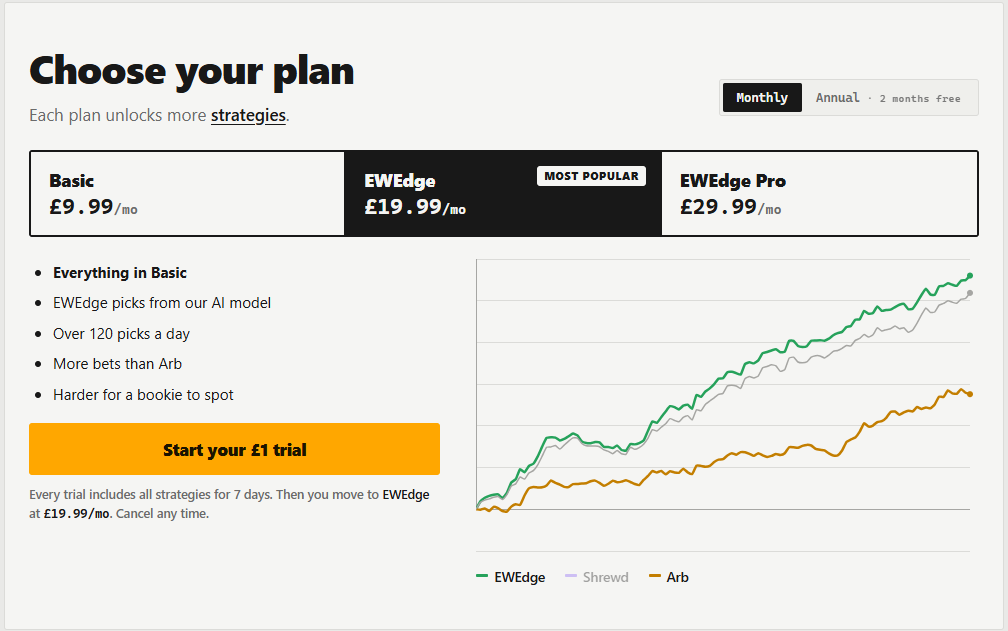
The three approaches have different characteristics, but they are not three entirely independent portfolios. Shrewd is a filtered subset of EWEdge selections, so their results must not be added together.
You can find further information on the official EWEdge website.
How does EWEdge work?
The service looks for horses whose available odds are considered generous relative to their estimated probability of winning or placing.
For example, a £1 each-way bet at 10/1 costs £2 in total. If the horse wins and the bookmaker offers one-quarter odds for three places, the winning and placing components both return money.
If the horse finishes in the places without winning, only the place component pays. If it finishes outside the places, the entire £2 stake is lost.
EWEdge’s approach aims to identify situations where the place component offers sufficient value to help compensate for the losses incurred on the win component.
This is important because the strategy does not depend on selecting winners at a high strike rate. Instead, it relies on obtaining sufficiently good odds over a large number of bets.
However, a theoretical advantage is only useful if the model estimates are sufficiently accurate and the bettor can actually obtain the prices being recommended.
EWEdge results: July to October 2026
The longer results record covers selections detected between 11 July and 25 October 2026, with results settled through 25 October. The stated methodology uses £1 each-way level stakes, selections with a modelled edge of at least 1%, decimal odds between 7.00 and 67.00, and picks shown at least 15 minutes before the race.
The following figures are reported in the supplied results sheets.
| Strategy | Bets | Total staked | Reported profit | ROI |
|---|---|---|---|---|
| Arb | 6,058 | £12,116 | £1,424.81 | 11.76% |
| EWEdge | 10,076 | £20,152 | £2,708.87 | 13.44% |
| Shrewd | 8,791 | £17,582 | £2,499.18 | 14.21% |
The results are encouraging on the face of it. All three strategies report positive returns over the period.
EWEdge recorded the largest reported profit at £2,708.87, while Shrewd recorded the highest ROI at 14.21%.
ROI, or return on investment, measures profit against the total amount staked. It is a useful way to compare performance, although it does not tell us how much capital a bettor needs to withstand losing runs or whether every recommended price was obtainable.
It is also important not to add the three profit figures together. Shrewd is a filtered version of EWEdge, meaning there is overlap between the selections.
These are promising historical results, but a positive return over several months does not establish that the same performance will continue.
Witnessed-price results: October 2026
The second set of results covers 4 to 25 October 2026 and focuses on selections with witnessed prices.
EWEdge defines a witnessed price as the bookmaker’s own price, or a price the bookmaker was seen offering, at the recommended price or longer while the selection was still available.
This is a useful distinction because a betting systems can appear profitable on paper but prove difficult to follow if the advertised prices are not genuinely available.
| Strategy | Bets | Total staked | Reported profit | ROI |
|---|---|---|---|---|
| Arb | 885 | £1,770 | £492.17 | 27.81% |
| EWEdge | 2,295 | £4,590 | £825.17 | 17.98% |
| Shrewd | 2,002 | £4,004 | £573.39 | 14.32% |
All three strategies again show positive reported returns.
Arb produced the highest ROI in this shorter sample at 27.81%, followed by EWEdge at 17.98% and Shrewd at 14.32%.
These figures strengthen the case for examining EWEdge further, but the witnessed-price sample covers only 22 calendar days. A short period can produce unusually high or low returns, particularly when a strategy involves longer-priced horses.
Witnessed prices are also not the same as independently verified customer execution. A price being observed does not establish that every subscriber could obtain it, at the desired stake, across every bookmaker.
Our view is that the witnessed-price results are useful supporting evidence, but they should not be treated as proof that every user can replicate the published returns.
EWEdge’s published all-time record
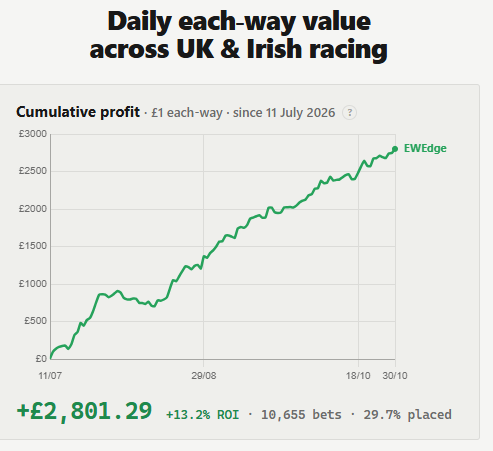
EWEdge also publishes a running “All” record on its performance page, again at £1 each-way stakes and odds of 7.00 to 67.00. We show it separately from the spreadsheet results above because the figures differ and no start or end date was supplied with it. The all-time figures should not be combined with the dated spreadsheet samples or treated as a direct reconciliation of them.
| Strategy | Bets | Total staked (our calculation) | Reported profit | ROI (as published) | Placed |
|---|---|---|---|---|---|
| Arb | 6,348 | £12,696 | £1,379.59 | 10.9% | 29.2% |
| EWEdge | 10,655 | £21,310 | £2,801.29 | 13.2% | 29.7% |
| Shrewd | 9,326 | £18,652 | £2,593.78 | 13.9% | 29.5% |
Total staked is bets multiplied by £2, as each £1 each-way bet is two £1 bets.
Strike rate
Between 30% of bets placed across the three strategies. Assuming “placed” includes winners, roughly seven in ten £1 each-way bets lose the full £2 stake. That fits the long-odds profile described in the losing-runs section below and is another reason to size stakes for a bank that can absorb long losing sequences.
How EWEdge describes its strategies
- EWEdge: Described as an AI model trained on thousands of past races, predicting each horse’s chance of placing. EWEdge says it finds over 120 bets a day, the most of its three strategies, and that by predicting early, while bookmakers are still forming their books, it can find picks that other strategies miss. It says these picks are harder for bookmakers to recognise as sharp, so accounts should last longer, and recommends this strategy if you are unsure.
- Shrewd: Shows only the EWEdge model’s bets that are not arbs, to keep accounts open for longer by avoiding the most obvious sharp bets.
- Arb: Backing horses at bookmakers whose implied place price is higher than the best price at the exchanges. EWEdge describes this as a decades-old method and the basis for its other strategies. It also states that bookmakers can quickly spot customers using the same comparison.
These are the service’s own claims. The performance records do not show how long accounts last under each strategy, so the account-longevity argument remains untested. EWEdge’s own comment about Arb is worth noting: the strategy with the best result in the short witnessed-price sample is also the one the service itself says bookmakers can most easily spot.
A loophole the bookies can’t close
EWEdge
Each-way terms are standard across the industry. Pricing the place part horse by horse would mean replacing each-way betting.
A bookmaker can cut the win price, which costs win-only business, or try to restrict value bettors. We created Shrewd mode so your bets draw less attention.
Does EWEdge beat the starting price?
One of the most useful tests of a betting service is whether it consistently secures odds better than the eventual industry starting price, commonly referred to as SP.
Oddschecker price verification: 29 – 31 October 2026
To test whether recorded prices could be found at the named bookmaker, we checked 28 selections against the relevant Oddschecker racecards on 29 – 31 October 2026. Each selection was recorded as a £2 total each-way stake (£1 win and £1 place). Oddschecker prices are a snapshot: prices can move, and a displayed price does not matched betting that a bookmaker will accept a particular stake. We therefore treat this as a one-day price-availability check, not proof of bet execution.
Odds mismatch
| Outcome | Selections | Share of 28 |
|---|---|---|
| Odds matched | 20 | 71.4% |
| Odds different | 8 | 28.6% |
| Total checked | 28 | 100% |
Selections requiring review
Changes are shown as the difference in decimal price. Higher available odds are treated positively, not as errors.
| Horse | Bookmaker | Recorded | Actual | Change |
|---|---|---|---|---|
| Measure Of A Man | BetVictor | 11.00 | 10.00 | -1.00 (-9.1%) |
| Marty McFly | Bet365 | 12.00 | 9.50 | -2.50 (-20.8%) |
| Brookie | BetVictor | 15.00 | 13.00 | -2.00 (-13.3%) |
| Lazare de Star | BetTom | 7.00 | 9.00 | +2.00 (+28.6%) |
| Lieber Nicc | BetTom | 12.00 | 13.00 | +1.00 (+8.3%) |
| Dancing Fruits | Sky Bet | 10.00 | 9.00 | -1.00 (-10.0%) |
| Messerschmitt | Bet365 | 10.00 | 9.00 | -1.00 (-10.0%) |
| Gibbs Island | Bet365 | 17.00 | 15.00 | -2.00 (-11.8%) |
Direction of the differences
| Direction | Selections | Share of all 28 | Share of the 8 differences |
|---|---|---|---|
| Actual price lower than recorded | 6 | 21.4% | 75% |
| Actual price higher than recorded | 2 | 7.1% | 25% |
Six of the eight differences showed a shorter actual price than the recorded price. Across those six selections, the average percentage shortfall was approximately 12.5%, calculated as the mean of each selection’s percentage difference from its recorded decimal price. Marty McFly had the largest shortfall at 20.8%. The two favourable differences, where the actual price was higher than recorded, were both at BetTom.
What the differences mean
| Price-check outcome | Selections | Interpretation |
|---|---|---|
| Actual price matched recorded price | 20 | No price discrepancy found at the time checked |
| Actual price was shorter | 6 | Potentially reduces returns and may weaken or remove the modelled edge |
| Actual price was higher | 2 | Favourable to the bettor; not a negative discrepancy |
| Total checked | 28 | Three-day snapshot only |
A shorter price does not automatically make a selection unprofitable. The effect depends on the model’s estimated probability, place terms and the size of the original edge. The six shorter prices should therefore be treated as candidates for recalculation, not as six proven losing bets.
Bookmaker breakdown
| Bookmaker | Different prices | Lower | Higher |
|---|---|---|---|
| Bet365 | 3 | 3 | 0 |
| BetVictor | 2 | 2 | 0 |
| BetTom | 2 | 0 | 2 |
| Sky Bet | 1 | 1 | 0 |
| Total | 8 | 6 | 2 |
Impact on betting performance
The important issue is whether the odds differences materially change the expected value of a selection.
- Higher actual odds: Positive for potential returns and value.
- Small differences: Generally unlikely to change the overall assessment on their own.
- Lower actual odds: Can reduce expected value and potentially turn a value bet into a marginal or negative-value selection.
- Significant differences: Need recalculating before accepting the original +EV figure.
EWEdge’s stated threshold is a modelled edge of at least 1%, and its own loss-run modelling assumes an edge of around 10%. Against that background, a price that is 10% to 20% shorter than recorded is not trivial. For selections that were close to the 1% threshold, a shortfall of that size could remove the edge entirely, and even for larger edges it could remove a meaningful share of it. We have not recalculated the expected value of each affected selection, so this should be read as a risk indicator rather than a measured loss.
What the verification does and does not show
- 20 of 28 selections (71.4%) matched the recorded odds at the named bookmaker at the time of our check.
- Eight prices differed (28.6%). Six actual prices were shorter than recorded; two were higher and therefore favourable to the bettor.
- All six shorter prices were at Bet365, BetVictor or Sky Bet. Both higher prices were at BetTom.
- The sample is small: 28 selections, checked on one day, with only eight differences. It should not be treated as a reliable estimate of the service’s long-term price availability.
- A price difference does not itself prove that a bet could not have been placed earlier, nor does a displayed price prove that a customer could obtain the desired stake. The check is a useful warning about price sensitivity, not an audit of execution.
Losing runs: what should you expect?
One of the biggest challenges with any betting strategy is dealing with losing runs. This is particularly relevant to EWEdge because its selections are often at relatively long odds.
In its Losing Runs analysis, EWEdge states that its each-way value bets average approximately 14.6 in decimal odds. Allowing for bookmaker margin, it assumes a win rate just below 7%.
In simple terms, winners are expected to be relatively infrequent.
EWEdge’s strategy aims to identify bets where the place component provides sufficient value to compensate for expected losses on the win component. However, this does not prevent extended periods without a winner, and the place component will not always produce a return.
Expected profit and the chance of losing
EWEdge models the expected results using a 10% edge rather than the 13.0% historical return cited in its analysis. It uses a 6.9% win rate and assumes independent bets.
Its published estimates for £1 each-way level stakes are shown below.
| Bets | Expected profit | 68% modelled interval | 95% modelled interval | Chance of a loss |
|---|---|---|---|---|
| 50 | £10 | -£30 to £50 | -£69 to £89 | 44% |
| 200 | £40 | -£39 to £119 | -£118 to £198 | 32% |
| 500 | £100 | -£25 to £225 | -£150 to £350 | 21% |
| 1,000 | £200 | £23 to £377 | -£154 to £554 | 12% |
These figures demonstrate the difference between expected profit and actual results.
After 50 bets, the model estimates a 44% chance of finishing at a loss. Even after 1,000 bets, the estimated probability of an overall loss remains 12%.
The 95% modelled interval after 1,000 bets ranges from a loss of £154 to a profit of £554.
These are estimates based on EWEdge’s assumptions, not guarantees of what subscribers will experience. If the actual edge is lower than expected, the prices are not consistently obtainable, or the outcomes differ from the model, the results could be worse. Our Oddschecker check suggests the price risk is real.
Drawdowns: how far could profits fall?
A drawdown is a decline from a previous peak in cumulative profit. A bettor can finish a period in profit and still experience a substantial drawdown along the way.
EWEdge reports the following maximum drawdowns from 10,000 simulated sequences at £1 each way.
| Bets | Median maximum drawdown | 95th-percentile maximum drawdown |
|---|---|---|
| 50 | £28 | £55 |
| 200 | £61 | £117 |
| 500 | £92 | £179 |
| 1,000 | £123 | £233 |
The median is the middle result across the simulations. The 95th percentile means that 95% of the simulated maximum drawdowns were no greater than the stated figure, while 5% were larger.
The model suggests that a drawdown of more than £100 is a realistic possibility over a sequence of several hundred bets at £1 each way. At 1,000 bets, the 95th-percentile maximum drawdown is £233.
These are simulated figures, not independently verified predictions. Actual drawdowns can be higher or lower.
Our view on losing runs
We welcome the fact that EWEdge discusses losing runs and provides numerical estimates rather than focusing solely on headline profits.
However, potential subscribers should not assume that a positive historical ROI means they will make money. A strategy can have a positive expected return and still produce a long losing period or finish a particular sample in the red.
Anyone considering the service should use stakes they can afford to lose, maintain a dedicated betting bank and avoid increasing stakes to recover losses.
EWEdge’s further guidance is available in its How Much to Bet guide and Flat Staking vs Backing to Win guide.
What are the advantages of EWEdge?
A substantial record of selections
The longer results record contains thousands of bets across the three strategies. This gives readers more information to examine than a service that publishes only a handful of winning selections.
A focus on value
The service focuses on odds relative to estimated value rather than simply selecting horses expected to win. This is an appropriate approach for a strategy aiming to generate a positive expected return over time.
Price information is provided
The records include bookmaker odds and industry starting prices, allowing readers to examine whether the service tends to obtain prices above SP.
Witnessed-price results
The separate witnessed-price record is a useful addition because it attempts to address the difference between theoretical odds and prices observed while a selection was available.
Most prices held up in our check
20 of the 28 selections we checked against Oddschecker matched the recorded odds, and two of the eight differences were in the subscriber’s favour.
Losing-run analysis
EWEdge acknowledges the possibility of losing periods and publishes modelled estimates of the uncertainty surrounding its expected returns. This is important information for anyone considering a long-odds betting strategy.
What are the disadvantages and risks?
Results are not independently audited
The supplied spreadsheets are detailed, but that does not establish that an independent third party has verified every selection, price, stake and settlement.
The figures should therefore be understood as reported results rather than independently certified performance.
Historical returns may not continue
The longer record covers roughly three and a half months, while the witnessed-price record covers just over three weeks.
Neither period establishes how the strategy will perform across different racing seasons, market conditions and extended losing runs.
Obtaining the recommended odds may be difficult
A bookmaker may change its price, reject a bet or accept only a small stake. The practical value of a selection depends on the odds and stake a customer can actually obtain.
In our Oddschecker check, 28.6% of selections had a different price. Six of the eight differences were shorter than recorded, with an average percentage shortfall of about 12.5% across those six selections. The witnessed-price record is helpful, but it does not establish that every subscriber can reproduce the recorded results.
Bookmaker restrictions remain a concern
Successful betting can lead to reduced stakes or account restrictions. EWEdge’s Shrewd strategy is intended to address this practical issue, but the supplied results do not establish how much it reduces restriction risk or how long customer accounts will remain usable.
Subscription fees reduce net returns
A positive betting return is not the same as a positive net return after all costs.
The subscription fee, any exchange commission where applicable, missed prices and the practical limitations of bookmaker accounts should all be considered when calculating the value of the service.
EWEdge pricing: is it worth the money?
EWEdge advertises a £1 seven-day trial, followed by £19.99 per month for its main plan. Lower-priced access is also advertised for Arb. Check the official website for the current subscription options and terms before signing up.
The monthly fee may be reasonable for a bettor who can consistently follow the selections at the recommended odds and obtain enough betting volume to justify the cost.
However, the trial is too short to establish whether a strategy is profitable. It is better used to assess the interface, selection frequency, price availability and practical requirements.
The real test is whether a subscriber can achieve a positive return after subscription fees and other costs, while managing the risks of losing runs and bookmaker restrictions.
How much could you realistically make?
The published ROI figures are attractive, but multiplying them by a larger betting bank does not guarantee a proportional increase in profits.
For example, a 13.44% ROI on £2,000 of total stakes would imply £268.80 in profit before subscription fees and other costs.
It assumes that the same return can be achieved on the larger volume of bets, with the same prices and level of stake acceptance.
A realistic assessment needs to consider:
- The size of the betting bank.
- The total amount staked, including both parts of each-way bets.
- The frequency and severity of losing runs.
- The proportion of recommended prices that can actually be obtained.
- Subscription fees and other execution costs.
- The effect of bookmaker restrictions on the number and size of bets available.
The key question is not simply whether EWEdge’s historical results are profitable. It is whether a typical subscriber can reproduce those results in practice.
Who might benefit from EWEdge?
EWEdge may be worth investigating for bettors who understand each-way betting, can maintain accounts with multiple bookmakers, have sufficient funds to manage variance and are prepared to keep their own records.
It is less suitable for anyone expecting guaranteed income, effortless profits or a service that removes the risk of betting.
Anyone considering EWEdge should be comfortable with the possibility of losing money and should never stake funds needed for essential household expenses.
Our EWEdge verdict
EWEdge presents an interesting case. Its supplied results show positive reported returns across Arb, EWEdge and Shrewd over the period examined. The separate witnessed-price record also reports positive returns, while the starting-price comparisons provide further information about the prices recorded. EWEdge’s all-time performance page tells a similar story, with ROI of 10.9% for Arb, 13.2% for EWEdge and 13.9% for Shrewd, all comfortably above 10% across thousands of bets.
The strongest features are the emphasis on value, the volume of recorded selections and the inclusion of information that allows readers to examine the performance beyond a simple list of winners. We also welcome the published losing-run analysis, which acknowledges that a positive expected return can coexist with significant drawdowns and a meaningful chance of finishing at a loss.
Our own Oddschecker check gave a mixed picture. Twenty of the 28 selections (71.4%) matched the recorded price at the named bookmaker. Of the eight differences, six were shorter than recorded and two were higher. The shorter prices matter because they can reduce the expected value of a selection, particularly where the original modelled edge is small. However, this was a three-day check of a small sample and does not establish the long-term rate at which subscribers can obtain the published prices.
There are also important caveats. The results have not been independently audited in the material examined, the observation periods are limited, and witnessed prices do not necessarily prove that every customer can obtain the same odds and stakes. Bookmaker restrictions and subscription costs also affect the practical value of the service.
Our verdict: Recommended. The supplied records report ROI above 10% on all three strategies across thousands of bets, and the service has a clear value-based approach. Our three-day Oddschecker check found that 20 of 28 prices matched at the named bookmaker; six of the eight differences were shorter than recorded, while two were higher. This is a useful warning about price sensitivity, but it is too small a sample to establish typical price availability. For bettors considering the service, the £1 trial is best used to test the interface, selection frequency and—most importantly—whether the recommended prices and meaningful stakes are actually obtainable. Keep an independent record of the prices you can get and the bets you place.
As with any betting service, profits are not guaranteed, losing runs are normal for long-odds each-way betting, and bookmaker restrictions or shorter prices can reduce what you earn. Independent auditing, a longer track record and repeated price checks across different dates would strengthen the case. On the evidence available, EWEdge is worth testing cautiously, but we would not treat the published ROI as a return that every subscriber should expect.
FAQ