
Best Horse Racing Form and Stats Websites

The Importance of Horse Racing Stats in Modern Betting
In today’s betting landscape, horse racing statistics play a crucial role in making informed wagers. Understanding the numbers behind each race can significantly enhance your chances of success, allowing you to move beyond simple odds analysis. Here’s why stats are so important in horse racing:
1. Form Analysis
When assessing a horse’s potential performance, form is everything. Statistics provide a comprehensive view of a horse’s recent performances, including:
- Win Rates: Knowing how often a horse has won in recent races can indicate its reliability and competitive edge.
- Race Conditions: Stats can reveal how a horse performs under different conditions, such as various track surfaces or weather conditions.
2. Understanding Reliability
A horse’s past victories can give insights into its consistency and reliability. For example:
- Sincerity in Performance: Frequent wins suggest that a horse is not only capable but also sincere in its efforts on the track. This can be a significant factor when deciding whether to place a bet.
- Historical Performance: Analyzing how a horse has fared against specific competitors or in certain types of races can help predict future outcomes.
3. Race Conditions and Going
The type of going (the condition of the track) can greatly impact a horse’s performance. Stats help you assess:
- Preferred Conditions: Some horses excel on soft ground while others perform better on firm tracks. Understanding these preferences can guide your betting choices.
- Adaptability: Statistics can also indicate how a horse has performed under various conditions, helping you to gauge its adaptability.
4. Gaining an Edge Over the Bookies
In the competitive world of sports betting, knowledge is power. The more stats you analyze, the better prepared you are:
- Data-Driven Decisions: Analyzing a wide range of statistics can help you make more informed decisions rather than relying on gut feelings or popular opinions.
- Identifying Value Bets: By understanding the stats, you can spot value bets where the odds offered by bookmakers may not accurately reflect a horse’s true chances of winning.
Conclusion
In summary, horse racing statistics are an essential tool for any serious punter. They provide critical insights that go beyond surface-level analysis, helping you to understand a horse’s form, reliability, and performance under various conditions. By leveraging this data, you can enhance your betting systems and gain a competitive edge over bookmakers. Remember, the more informed you are, the better your chances of success in the exciting world of horse racing!
How to Read Horse Form
Reading horse form is an essential skill for anyone looking to make informed wagers on horse racing. Understanding the information presented in a racecard can significantly enhance your chances of finding a winner. Here’s a guide to help you interpret horse form effectively.
1. Understanding Form Figures
Form figures are numerical representations of a horse’s most recent placings in races. They provide a quick snapshot of how well a horse has performed in its last few outings.
- Typical Format: The form is usually displayed as a sequence of numbers next to the horse’s name, such as “1-3-2-5”, representing the horse’s finishing positions in its last four races.
- Recent Performance: The most recent result is on the left, so in the example above, the horse finished 1st in its last race, 3rd in the one before that, and so on.
2. Decoding the Numbers
- Winning Positions: A “1” indicates a win, while “2” and “3” denote second and third places, respectively. The lower the number, the better the performance.
- Fallen or Unplaced: Numbers like “F” (fell), “PU” (pulled up), or “UR” (unseated rider) indicate that the horse did not finish the race in a conventional manner.
- Blank Spaces: If there are blank spaces or “0” entries, it may indicate that the horse did not compete in that race or finished outside the top finishers.
3. Additional Information on the Racecard
In addition to form figures, a racecard contains various other relevant information that can aid in your analysis:
- Race Conditions: Look for details on the type of race (flat, jumps, etc.), the distance, and the going (track condition). These factors can heavily influence a horse’s chances.
- Jockey and Trainer Stats: Information about the jockey and trainer can provide insights into the horse’s chances. A successful jockey-trainer combination often yields better results.
- Weight Carried: The amount of weight a horse carries can affect its performance. Lighter weights may benefit less experienced horses, while seasoned competitors may handle heavier weights better.
4. Contextualizing the Form
Interpreting form numbers in isolation can be misleading. Consider the following:
Rest and Recovery: Horses returning from a break may perform differently. Check how long it has been since their last race and how they fared prior.
Quality of Competition: A horse finishing 1st in a low-quality race may not be as strong as one finishing 3rd in a more competitive field.
Improvement Trends: Look for patterns in the form. A consistent improvement over recent races can indicate a horse is in good shape.

Age: Although it seems basic, a horse’s age is an important factor, and all racecards provide this information. There are several races that are only available to a specified age range. From a formal standpoint, taking into account a horse’s age in relation to other elements enables us to determine where the horse is in their career.
Trainer: As we learned in our trainer guide, the trainer is in charge of overseeing the upkeep, diet, and fitness of racehorses. They play a crucial role in a horse’s career and are in charge of all aspects of their success both on and off the track. When evaluating a race, it’s crucial to take the trainer’s recent performances and course records into account.
The jockey is one of the most crucial components of any competition since he or she is the human component of a horse race. By examining a person’s most recent and course form of a jockey, you can learn vital information about a rider’s performance credentials. It is always important to take note when a jockey has a history of success with a particular horse.
Ground: When evaluating a race, the state of the racing track, also referred to as the “Going,” is crucial. Every horse has a preference for either firm or soft ground. By examining the racing meeting’s ground description and comparing it with
Class – The class of the race will be shown in the race’s title, and by knowing the class of a competition, we can determine whether the horses entered in the race will be suited for the race. A horse moving up in class can be forced out of their familiar comfort zone, while a horse moving down in class might find themselves in a race that is easier to win than usual.
Weight: The importance of weight in a horse race is thoroughly explained in our handy Weight Guide. Weight is an important component of form analysis, affecting everything from how much weight a horse must carry due to official ratings and handicap races to the weight-for-age and sex concessions that are in effect.
Draw: On a level surface, the draw must be taken into account for a range of tracks and distances. The starting stalls for each horse are assigned according to the results of the draw. On some courses, a “broad” draw might be a significant disadvantage, and an inside draw can be problematic if the racing surface is known to be slower there. By looking at the number in brackets next to your horse’s number on the racecard, you can determine where it was drawn.
Headgear: Horses can wear a variety of headgear to sharpen their focus during a race; this headgear frequently significantly boosts a horse’s chances of success.“Blinkers” (B), “Hoods” (H) and “Cheekpieces” (P)
In order to help in this there is a selection of sites that will simplify the process and help with shortcuts for reading the form
TimeForm
Timeform provides these features for Free
- Tips Sheets – These provide tips of every race

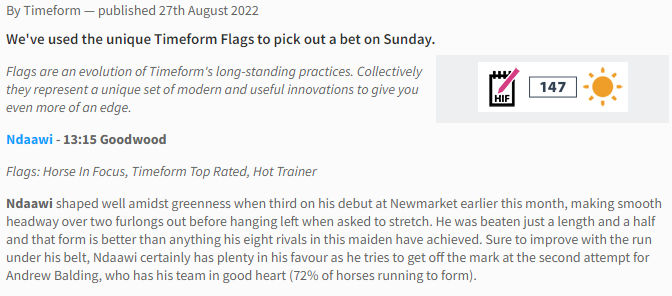
- Flags – Timeform has unique flags in order to make sense of the previous form. If you were to review pace, speed, won last time, beaten by favourite, and all the stats per race it would be too much info so Flags work out all this stuff so you can move on and predict the next race race
- Filters – You can filter for horses and races
- Flats or Jumps
- Winner last time out, In Form, Beaten Fav LTO
- Going
- Course
- Distance
- Search for trainers in form
- Jockeys in Form
- Stat Selector – This provides free stats of horses in races for the best bets
If you pay for a Day pass or Monthly you get the following
Race Passes are the ultimate form guide, providing Timeform analysis, Flags and ratings for every runner in every race in Britain and Ireland.
Enjoy the flexibility of race-by-race purchases, buy for one, three, seven or 28 days at a time – or bring the cost down to the equivalent of just a few pence per race by subscribing. With Race Passes, you’ll have access to additional features you won’t find on our Race Cards that add extra levels of insight, including:
- Complete performance histories for each runner plus video replays
- Full access to our extensive form archive including unlimited use of the Horse Search facility
- Data and statistics for jockeys and trainers
- Betting hints like the Pace map
- Live betting data and Betfair Exchange hi/lo record in results
ProForm Stats
With Proform you can build Build Profitable Systems in Minutes and use the Power, Speed and Pace Ratings to Uncover Patterns in a Horse’s Form

If you’re looking for a powerful horse racing form book, statistics, dynamic speed and form ratings and tissue prices then there is only one computer form database and research tool you should be using.
Proform is the choice of many TV horse racing pundits, professional punters and hobbyists, plus we provide racing statistics to many leading industry specialists.
Our professional form book has earned a reputation second to none, that’s why well known tipsters to TV pundits rely on our form book to pinpoint betting opportunities.
There are lots of Training modules, Daily stats, pace guide and jockeys rated on site
Racing Post
The Racing Post has been around for a long time and is a favorite of mine for many reasons.
As well as being able to buy the Racing post newspaper at the week you can get tips and stats of all the races. The race cards have a predictor that will show a video of the race with the predicted positions for all horses

They have a tipping column and latest news.
If you subscribe to the Racing Post you can get a full Horse stats, race replays, and a copy of the Racing Post.
- Read ante-post selections for key meetings from Tom Segal and our Pricewise team
- Study form with full replays from this and past seasons
- Enjoy exclusive 6pm nightly access to Pricewise and Paul Kealy’s tips
- Advanced form study with Pro Card
- Use expert ratings
- Horse tracker
- Statistics
- Results analysis
- Pedigree information
The Racing API
The Racing API provides access to an extensive live database, spanning 10+ years and holding over 200,000 racecards and results.
While the bulk of the data is focussed on UK & Irish racing, it also offers coverage of bigger races in over 25 countries globally.
You can connect to the API with any programming language of your choice, using your API keys that are provided upon sign up.
With racecard, results and odds updating every 10 minutes, it’s a good choice for developers or tech-savvy bettors who want to create horse racing software, scripts or web content containing live information.
As well as providing raw results data, The Racing API’s analysis endpoints can provide betting insights in an instant, computing the profitability of different parameters and conditions from thousands of historical results.
BetWise
BetWise tag line is Start taking the guesswork out of betting on horseracing
For free you can download daily sheets with the Betwise rank, market rank, early prices and value rating
They have a Smartform Racing Database comes with 15 years of horseracing results data (from Jan 1 2003) for all UK and Irish horse races, under both Flat and NH codes.
The database can be used to research, program and automate any task you can think of that requires horseracing data, such as:

- Creating winning methods and systems
- Backtesting for profitability
- Building machine learning models
- Creating speed and handicap ratings
- Creating your own custom racecards to incorporate your own edge – see example from yesterday’s racing
Combined with automatic betting techniques and Smartform’s Betfair ID lookup tables, the Smartform Racing Database also gives you all you need to create fully automated betting robots for horseracing.
You will need to purchase the historic data set in order to make use of the daily updates service.
Horse Race Base
Horse Race Base has a Database of powerful and unique racing solution for creating you own betting systems or you looking at the data.
You can setup My Horse to follow and these will alert you when they are next racing with your own notes
My Races these are races and tracks where you can break down horses for places, runs and wins.
Stats Analyzer and Collateral form Tool, Hot/Cold races, and stats so you can bet or lay horses.
The Stats Attack you can pick Trainers in form so you can filter your selections down and see the track percentage or win percentages with Strike Rates
The system Builder tool has filters for jockeys, UK and different races types, Hurdles, flats and select Jockeys to run a query across all the data to build up a system.
You can add in a lay or bet amount and run the system to work out from a starting bank, how much the strategy would have made.
At The Races
At The Races has standard race cards, also the populate
- Market Movers
- Replay of the racers
- Features a nice app for your phone
- Latest News
- Smart stats
- Blogs
- Huge Racing Tips section
- ATR predictor for all races

You can filter down to race courses and the top jockeys and trainers at that course